THE FACTS
The following presents the core realities and evidence behind the NUMBERS movement. Explore the data-driven foundation behind our mission. All information on this site is verified for accuracy.

17%
trust in congress
Research conducted by the Pew Research Center show that only 17% of Americans trust their government to do what is right “just about always” (2%) or “most of the time” (15%).
$635.6M
politician trading
Multiple sources report that members of Congress and their families executed 13,300 trades totaling roughly $635,600,000 in 2025. Of these, six members of Congress disclosed 11 stock transactions worth more than $1 million, raising concerns about insider trading.
2X+
PAID TO CONGRESS
Per Congress, "the compensation for most Senators, Representatives, Delegates, and the Resident Commissioner from Puerto Rico is $174,000," more than double the median annual amount earned by other US citizens: ~$70,000.
$15,520B
2024 pac spending
Political Action Committees (PACs) are organizations that raise and spend money to influence elections and policy. The Federal Election Commission reports that, for election cycle 2023-2024, PACs disbursed a total of $15,520,325,323.00.
money = influence
(and victory).
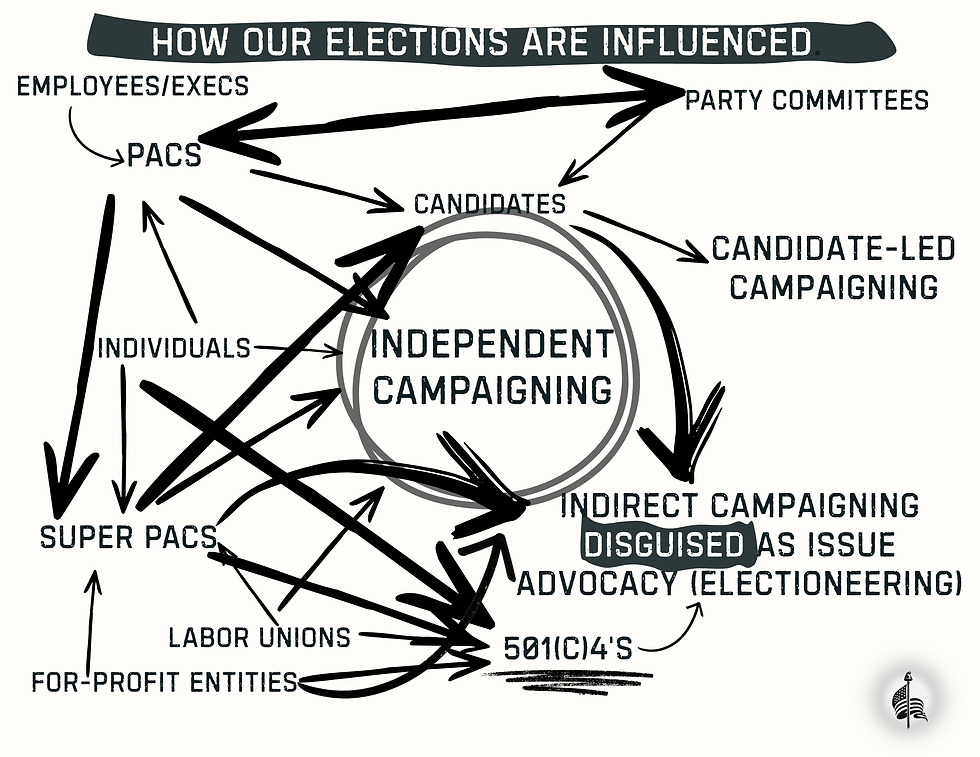
Confusing, right? That's how they designed it.
Political opinion is mostly shaped by three forces: Direct Campaigning (a candidate’s own messaging and platform) ; Independent Campaigning (outside parties promoting or attacking a candidate) ; and Strategic Issue Advocacy (disguised influence where ads focus on sensitive topics to indirectly nudge voters toward or away from a candidate).
The common denominator behind these forces is... money. A sprawling network of Political Action Committees (PACs), Super PACs, 501(c)(4) nonprofits, party committees, for-profit entities, and even single individuals pours billions into shaping your opinion to secure a victory at the polls.
The result? Our senses are overloaded, our realities are warped, and our emotions are played, all the way up to election day.
So what do we do? Let's consider election manipulation as an enemy with several heads. You can cut one off, but another will be left to bite you. If we ban PACs, the money once funneled through those will just be diverted to the remaining elements of the network. If we put a hard stop on independent campaigning, we risk trading individual freedom for the idea of reform.
We need a total system cleanup that protects our right to speak while cutting off every head of corruption at once. This requires a sweeping, strategic plan that hits the problem from every angle: (1) fixing the way candidates campaign, (2) banning PACs and Super PACs to stop massive, hidden piles of cash from running the show, (3) limiting independent campaigning to individuals and for-profit entities only, (4) setting strict limits on how much individuals and companies can spend to influence an election, and (5) cracking down on ‘fake’ issue ads that are really just campaign commercials in disguise.
If we are successful, we level the playing field for every candidate—and finally give the power of the informed vote back to the people.
the election algorithm
Money isn't the only thing ruling your perception. In the 1930s, Franklin D Roosevelt successfully hid the full extent of his polio-induced paralysis from the general public through means of metal leg braces, hidden wheelchairs, and photograph suppression. Today, your perceptions are similarly manipulated with camera angles, timed applause, biased media, and... technology, of course. Let's talk about how social media and AI can influence US politics.
Bots on social media argue with people on political posts, further dividing us.
AI enables the mass production of fake news, images, and videos. We no longer know what's real.
AI tailors political ads to psychological profiles - they show political ads to people likely to be influenced.
Algorithms use doomscrolling to keep you engaged. The time you spend on your phone is more profitable than your mental wellbeing.
Engagement algorithms boost content that keeps your attention - often through outrage or anxiety.
Personalized feed erases a shared reality. When all we see is content we agree with, we think the majority of Americans agree with us too - even if they don't.
TRIBALISM
WHAT IT IS
At its core, tribalism is the tendency to divide the world into "us" and "them," prioritizing loyalty to one's own group above broader reasoning, evidence, or shared humanity. Historically, your tribe kept you alive. It's deeply wired into our DNA and psychology. That instinct doesn't disappear just because the context changes. And it isn't inherently flawed, but it becomes a liability when we let it cloud our judgment and override our common sense.
Why you should care
When it comes to politics, tribalism is a major contributor to division - and gridlock. By presenting complex issues to the public as simplistic 'Us vs. Them' narratives, our leaders gain popularity but fail at leading us towards real, achievable change, which is often obtained through the principled compromise of many schools of thought.
Tribalism manifests as party loyalty overriding policy judgment - voting against your own interests to oppose the other side, dismissing evidence because of who presents it, and treating political opponents as enemies rather than fellow citizens with different views.
The mess media
A handful of conglomerates controls a large share of US mass media.
Recent analyses show a shift toward "audience capture" within major American news outlets. By carefully choosing words that will keep us emotionally engaged, media entities have monetized social division. The same story is often told different ways in order to maximize attention from a target audience. For example, consider two different headlines of the same story: "Fed’s Rate Hike Threatens to Crush Working Families" vs. "Fed Moves to Rein in Out-of-Control Inflation and Restore Fiscal Discipline." The result is a system that values narrative-driven profit over objective truth.
"The big three" own material shares in each of these conglomerates.
palantir
Palantir is a software company that specializes in data integration, data analysis, and surveillance.
It has been embedded into these facets of american government:
IRS
DOJ
FEMA
FAA
DOD
SSA
CBP
CDC
NSA
FBI
ICE
CIA
FDA
USMC
HSI
US ARMY
USDA
US AIR FORCE
NASA
HHS
DHS
Palantir is a software company that specializes in data integration, data analysis, and surveillance.
It has been embedded into these facets of american government:
IRS
DOJ
DOD
SSA
FEMA
CBP
FAA
FBI
CDC
NSA
USMC
ICE
CIA
FDA
HSI
US ARMY
USDA
US AIR FORCE
HHS
DHS
NASA
The Role of NGOs
Non-Governmental Organizations (NGOs) are groups that operate independently from any government. They are usually non-profits and are set up to address specific social, environmental, or political issues. Sounds great, right? Well...
NGOs are often made up of wealthy and influential people - they have money and pull that the average citizen does not. Further, they have an extensive history of lobbying and shaping domestic and foreign policy, even though many claim to be "just discussing" issues. In other words, groups of wealthy elites are strategizing for your future with no oversight.
Need more evidence? It is a little-known fact that intelligence agencies from multiple different countries use NGOs for espionage activities. Because aid workers and researchers often have access to remote or restricted areas that diplomats cannot visit, they can collect information without raising as much suspicion. It seems these organizations are rife with secrecy.
Two NGOs you need to be aware of are the World Economic Forum (WEF) and the Trilateral Commission. Both had ties to Epstein, and both host members of major wealth and influence. Visit "The Fringe" page for more information.
THE EPSTEIN FILES
On November 19, 2025, the "Epstein Files Transparency Act" came into law. This required the Attorney General to publicly release all unclassified documents and records relating to the Jeffrey Epstein investigation.
The files turned over were incomplete and heavily redacted, hiding the names and images of many associates and co-conspirators of Esptein; this is a direct violation of the Transparency Act, which states that "no record shall be withheld, delayed, or redacted on the basis of embarrassment, reputational harm, or political sensitivity, including to any government official, public figure, or foreign dignitary." In contrast, the names and images of several victims (including images of their naked bodies) were exposed to the public. Additionally, former Deputy AG Todd Blanche acknowledged that roughly 3 million additional files were not released due to various reasons, such as attorney-client privilege, duplicity, graphic material, and victim protection; only the latter two are permitted exclusions under the Transparency Act.
These files don't just record heinous crimes against children. To be clear, those victims are the priority, but it's also worth noting that the files reveal how some of the world's most powerful people really see us. Epstein and other elites referred to the public as 'cattle' and openly discussed the mass execution of the elderly and the disabled. They even compared 'unused people' to 'unused neurons,' suggesting society should simply trash them the way the brain clears out old cells. (file numbers: EFTA02334064, EFTA02658640, EFTA00823256, & EFTA00823302).

individuals appearing in the epstein files
Inclusion in the Epstein files or association with Epstein himself does not in itself imply wrongdoing or guilt. This is not a comprehensive list.
POLITICIANS
- Alex Acosta - former US Secretary of Labor
- Andrew Mountbatten-Windsor - former Prince of Britain
- Bill Clinton - former US President
- Bob Kerrey - former US Senator
- Donald Trump - US President
- Ehud Barak - former Prime Minister of Israel
- George Mitchell - former US Senate Majority Leader
- Howard Lutnick - US Secretary of Commerce
- Jack Lang - former French Minster of Culture
- Joanna Rubinstein - former chair of Sweden for UNHCR
- Larry Summers - former US Secretary of the Treasurer
- Miroslav Lajcak - Slovak diplomat
- Mona Juul - Norway's former ambassador to Jordan and Iraq
- Noam Chomsky - American linguist and political activist
- Peter Mandelson - former British ambassador to the US
- Sarah Ferguson - former Duchess of York
- Steve Bannon - former Senior Council to President Trump
- Terje Rod-Larsen - former CEO of International Peace Institute
- Thorbjorn Jagland - former Prime Minister of Norway
- Chris Tucker - comedian & actor
- Keven Spacey - actor
- Mick Jagger - musician
- Peter Attia - longevity doctor and influencer
- Woody Allen - filmmaker
CELEBRITIES
- Alan Dershowitz - lawyer
- Ariane de Rothschild - CEO of the Edmond de Rothschild Group
- Bill Gates - co-founder of Microsoft
- Borge Brende - former CEO of World Economic Forum
- Dean Kamen - American engineer & businessman
- Elon Musk - founder of SpaceX
- Jean-Luc Brunel - French modeling agent
- Jeff Bezos - founder of Amazon and Blue Origin
- Kathryn Ruemmler - former Obama administration lawyer
- Leon Black - American investor
- Les Wexner - American billionaire
- Mark Zuckerberg - Meta CEO
- Marvin Minksy - AI pioneer
- Peter Thiel - German-American billionaire entrepreneur
- Richard Branson - founder of the Virgin Group
- Sergey Brin - co-founder of Google
- Sultan Ahmed bin Sulayem - Emirati businessman
- Thomas Pritzker - former executive of Hyatt Hotels
BUSINESs & Law
we argue.
society suffers.
"[Gen Z is] the first generation in modern history to score lower on standardized academic tests than the one before it."
— Dr. Jared Cooney Horvath, PhD, MEd Neuroscientist and Educator
"Politics, it seems to me, for years, or all too long has been concerned with right or left instead of right or wrong."
— richard armour, writer
We have so much evidence that technology, as it's currently used, is eroding empathy. And yet, we are barreling on.